
The truth about protein in menopause and how to cut through the fat…..
Will Increasing Your Protein Intake Reduce Menopause Belly-Fat?
There is SO much information on the internet about protein needs, amounts, sources, benefits, effects etc that it’s not surprising that alot of my clients are very confused about what to do so, as always, let me cut through the waffle and give you a science-based guide to protein for women who want real results ie. YOU!
If you’re noticing that belly-fat during menopause feels stubborn and relentless, you’re far from alone. Midlife body changes especially around the abdomen are one of the most common frustrations I hear from women I coach at Menopause Thrive Hub. The good news? Increasing your protein intake strategically can be part of the solution, not because it’s some magical fat-burning trick, but because of what it actually does to your muscle, metabolism and appetite.
Fat cells have a secret life.
If women have a lot of deeper visceral fat, then the fat cells are storing and producing oestrogens that are sourced via the diet, medications, chemicals and plastics (known as xeno-estrogens). All oestrogens however are recycled in the gut and for many overweight or obese women, these excess and recycled oestrogens, may be metabolised differently especialy if they also have a fatty liver.
There are also changes occuring in our muscles (especially the mitochondria in skeletal muscle which are the organelles that help to ‘burn fat’). With changes occuring in the size and density of muscles (sarcopenia), then there are inflammatory changes that may be occurring within the mitochondria, which are also ageing.
Muscle tissue is replete with oestrogen receptors, which is why, when oestrogen is declining, there is now such an emphasis on very high protein diets and resistance training. This is why, for women wanting to manage their weight, or to lose weight, then it’s important to understand protein requirements to offset muscle tissue breakdown and to maintain metabolism.
Muscles are at the heart of your metabolism, as is the liver and gut.
Let me break it all down for you:
In this post you’ll discover:
Why standard protein guidelines are outdated for menopausal women
How ageing and sedentary habits change your protein needs
Why muscle quality matters more than body weight
How to make smarter decisions based on your age and activity level
Actionable steps you can implement now, plus how coaching can support you
The Real Story Behind Menopause Belly-Fat
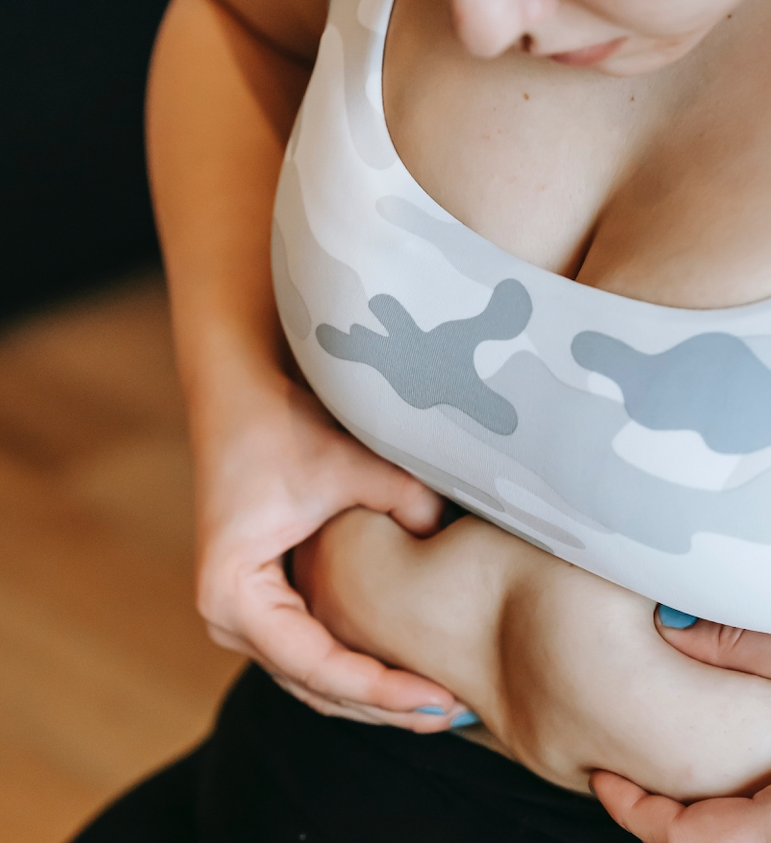
Stubborn belly fat is one of the most common symptoms of menopause (often despite not changing your habits)
First: I always tell my clients that menopause belly isn’t about willpower but that it’s biology.
As oestrogen declines, your body shifts more calories toward fat storage, especially visceral fat around the abdomen but that isn’t the whole story. Research has uncovered something called the Protein Leverage Effect which is a metabolic mechanism that may be driving overeating and weight gain during menopause. When your body isn’t getting enough protein relative to its needs, appetite rises in an effort to meet that protein target, which often leads to excess calories from carbs and fats and ultimately more belly-fat.
But protein has another powerful role here: it is critical for muscle health and muscle is the biggest engine for fat loss and metabolism. Women in midlife are up against anabolic resistance ( a blunted muscle response to protein and exercise) that means your muscles literally need more protein to do the same job as when you were younger. Read that again: we now need more protein to fulfil the same task as when we were younger.
Outdated Protein Guidelines: Why They Don’t Work for You
Most standard nutrition recommendations the 0.8 grams of protein per kilogram of body weight , were designed to prevent disease, not to optimise body composition or counteract aging biology. As we age, especially through menopause, both:
Muscle protein synthesis becomes less efficient
Appetite and hormonal signals shift
Energy expenditure declines
Because of this, many researchers and nutrition experts now recommend higher protein intakes for women over 50 — not just to preserve muscle, but to support bone health, improved metabolic function and better appetite control.
In fact, evidence suggests that aiming for around 1.0–1.4 g/kg/day of protein (or about 20–30% of total calories from protein) can be beneficial for menopausal women as that is enough to reduce muscle breakdown and help control appetite without overwhelming your liver or gut. Not overwhelming your liver is absolutely crucial in menopause as it is a key agent in helping you transition through menopause due to its functions including removing excess oestrogens and helping break down fat.
Gabrielle Lyon’s Cutting-Edge Perspective: Protein + Muscle = Metabolic Advantage
Dr Gabrielle Lyon is one of the leading voices in muscle-centric medicine and she emphasises that muscle is the metabolic organ that determines how your body uses calories, stores fat, and responds to food. As you age and become more sedentary (which is common around menopause), your muscles become less responsive to protein’s anabolic signal. You’ve probably not come across this before and sounds completely the opposite to what you thought. In layman’s terms, that means:
You need more protein per meal to stimulate muscle building
If you’re not doing resistance training, your protein needs are even higher
Otherwise, muscle continues to decline — and with it, metabolism slows further
This is what researchers call anabolic resistance — and it happens even in relatively healthy older adults. Overcoming anabolic resistance isn’t just about eating lots of protein; it’s about eating enough protein at the right times and combining it with exercise that stimulates muscle.
Dr Wendy Sweet’s Menopause Protein Insights
Dr Wendy Sweet, PhD (who is incidentally my coach!) offers a practical, evidence-based view that protein isn’t a “silver bullet,” but it is a crucial part of managing menopause belly and metabolic health. Her research-informed guidance highlights are that Menopause brings inflammatory changes in muscle and metabolism that can influence weight gain because as estrogen levels decline, muscles, especially their mitochondria, shrink and lose density, which not only reduces metabolic efficiency but also makes muscles less effective at using nutrients, contributing to changes in body composition and increased appetite for protein when the diet isn’t adjusted accordingly.
Too little protein may accelerate muscle loss, further slowing metabolism and increasing the likelihood of fat storage, but too much protein (particularly without adequate exercise or with compromised liver and gut health) may simply provide excess energy that stresses these systems and gets stored as fat, underscoring the importance of metabolic context, not just protein quantity.
Based on current evidence, a targeted protein intake of about 1.0–1.4 g/kg/day, accounting for roughly 20–25 % of total calories, offers a solid starting point for many women navigating menopause and metabolic changes, with adjustments made as activity increases or metabolic health improves. Importantly, Dr Wendy Sweet emphasises listening to your body and paying attention to overall metabolic health — including gut and liver function — rather than focusing solely on protein numbers, because hormonal, digestive, and metabolic systems interact in complex ways during midlife transitions and influence both fat distribution and muscular resilience.
Why Muscle Quality Matters More Than the Scale
Here’s where most diets get it wrong: they chase lower weight, not better body composition. You can lose weight but if a significant portion of that is muscle, your metabolism slows, cravings worsen, and belly-fat becomes harder to shift.
Muscle quality — meaning preserved strength, function, and metabolic activity — improves:
Resting metabolism
Blood sugar control
Appetite regulation
Fat distribution (especially around the waist)
Protein supports lean mass and, when paired with resistance training, helps shift your body from a “fat-storing” mode to a fat-utilising, muscle-preserving state.
Actionable Protein Strategy for Menopause Belly-Fat
Here’s a simple, practical framework:
Target ~1.0–1.4 g/kg/day of protein as a base — more if you’re lifting regularly or very active.
Distribute protein evenly across all meals — aim for ~25–40g per meal.
Prioritise high-quality sources: lean meats, fish, eggs, dairy, legumes, tofu, tempeh, and whey or plant-based protein if needed.
Pair protein with strength training 2–4 times per week. Even light resistance work dramatically improves how effectively your body uses protein.
Balance overall nutrition so extra protein doesn’t translate to extra calories from fats or carbs if weight loss is your goal.
Your Next Step: Individualised Coaching That Works
Protein alone won’t magically shrink belly-fat — but when it’s part of a personalised strategy that includes movement, lifestyle tweaks and accountability, you will see real change.
At Menopause Thrive Hub, we work with women to:
Set protein targets that match your unique biology and goals
Build strength-boosting routines that counteract anabolic resistance
Make nutrition practical, enjoyable and sustainable
Turn menopausal metabolic changes into opportunities, not obstacles
If you’re ready to move beyond generic advice and finally get a plan that delivers results, this is your invitation.